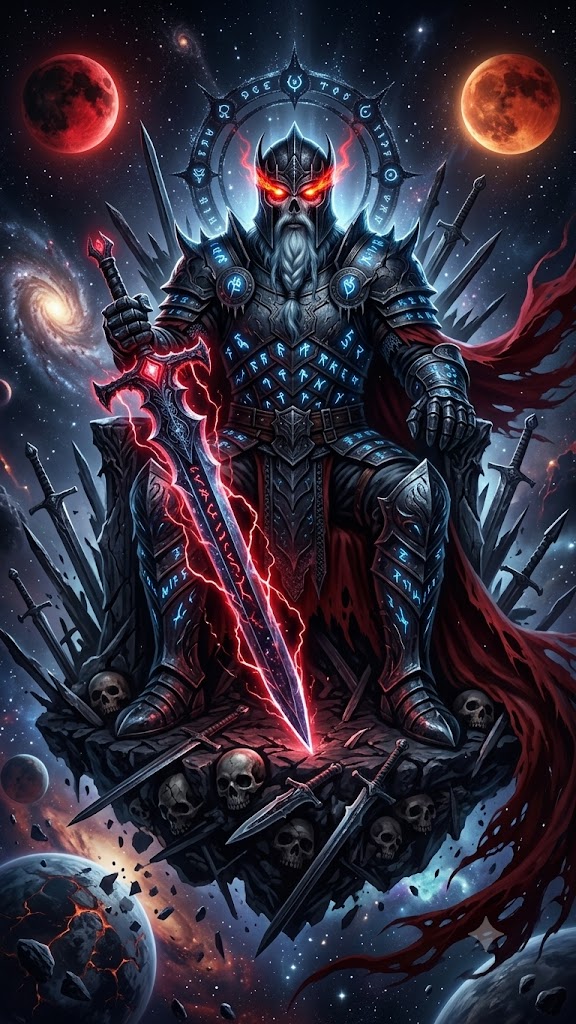
Divine Overview
The youngest name in the pantheon, and the one every other god watches most closely.
Warlords, mercenary companies, the vengeful, and the ambitious dying who'd rather not stay that way. Horkos has no formal priesthood to speak of yet, only an audience that grows every time someone decides death is negotiable.
The Odium
A king who refused to die, and kept refusing long after that stopped being impressive.
I. Born of Seug
Horkos was born in Seug on the 7th day of Azure Summer, Year 0, the same day that now anchors the modern calendar's count. He rose through Seug's political structure at a pace that startled even his allies: Highlord by twenty-two, Duke by thirty-five, and Kingpriest by forty-eight, one of the fastest elections to that office on record. He held the crown for decades after, aging as any mortal does, until at sixty-two the long-simmering war between Voir and Seug finally broke into open ground fighting, a war to keep Seug sovereign against the advancing Monitors, and one an aging king could no longer personally win with a blade.
II. The Warrior King
Long before he was a god, Horkos was a mortal king of Seug, a brilliant tactician who led his people through a long, grinding period of open warfare against Voir. He was, by every surviving account, exactly as ruthless as the job demanded and not one degree more, which in Seug's court politics made him something close to beloved. But a king's body ages at the same rate as anyone else's, and as his natural life ran out, Horkos found the prospect of dying, after everything he'd built, everything he'd won, entirely unacceptable.
III. The Pact
Rather than let death collect what it was owed, Horkos forged a dark pact and became a Death Knight, sovereignty traded for permanence, mortality traded for something that could keep winning wars indefinitely. The bargain worked exactly as advertised. It also opened doors that a living king would never have found: Horkos became a prominent member of the Cadaverous Coven, a cabal of five immortal undead beings whose ambitions run considerably longer than any mortal war ever could.
IV. Ascension
It was through the Coven's circles that Horkos eventually found the Divine Well and did what he has always done best, took what looked impossible to take. He absorbed its power and rose to full godhood: the newest name in a pantheon full of gods who measure their tenure in eons, not centuries. Whether the rest of the pantheon has fully reckoned with what that means yet is an open question. Horkos, for his part, has never once acted like he's still waiting for permission to belong there.
Divine Power
What it means to stand against a god who has already refused to die once.
He was a tactician before he was anything else, and godhood hasn't dulled that instinct, armies that march against whatever Horkos claims as his tend to discover their own plans were anticipated three moves in advance. He does not lose wars of attrition, because attrition was always his favorite weapon even when he was mortal, and death no longer costs him anything at all.
What he took on becoming a Death Knight, he has never given back. Wounds that would end a lesser king barely slow him; the grave he once refused holds no more claim on him now than it did the day he struck his bargain. Soldiers who fight under his banner report that fear moves differently around him. Not absent, but redirected, aimed at whatever stands opposite him instead of at the man himself.
Vengeance is not a passive portfolio for him. Wrong him, or wrong someone under his banner, and Horkos does not forget. He settles it personally, on his own schedule, and rarely in a hurry, because a god has nothing but time and he has never once been in a rush to prove a point twice.
The Cadaverous Coven does not name its members lightly, and Horkos earned his seat there the same way he earned everything else: by refusing every exit that would have made him smaller.
Gallery
Depictions of the Odium, as rendered by mortal hand.